
Biography
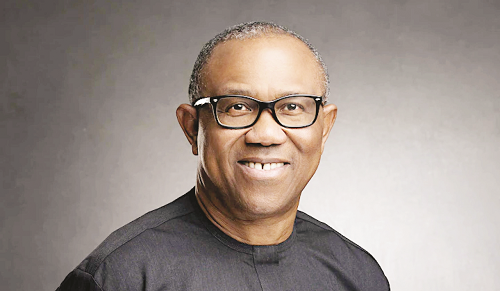
Peter Gregory Obi was born on 19 July 1961 in Onitsha, in present-day Anambra State, and is from Agulu in Anaocha Local Government Area. He attended Christ the King College, Onitsha, and graduated from the University of Nigeria, Nsukka, in 1984 with a Bachelor of Arts degree in Philosophy.
Biographical profiles published by Obi and by organisations associated with him list executive-education programmes at Lagos Business School, Harvard Business School, the London School of Economics, Columbia Business School, the International Institute for Management Development, Kellogg School of Management, Oxford's Saïd Business School and Cambridge Judge Business School. These are executive or certificate programmes, not additional academic degrees. A widely circulated claim that Obi holds a doctorate is false; his publicly established university degree is the bachelor's degree from the University of Nigeria.
Obi married Margaret Brownson Obi in 1992. They have two children. Before politics, he worked in trading, banking and financial services, eventually holding a series of board and chairmanship positions.
Private Business Career
The public record consistently associates Obi with the following former private-sector roles: Chairman of Next International Nigeria Limited; Chairman of Fidelity Bank Plc; Chairman of Guardian Express Mortgage Bank Limited; Chairman of Future View Securities Limited; Chairman of Paymaster Nigeria Plc; Director of Guardian Express Bank Plc; Director of Chams Nigeria Plc; Director of Emerging Capital Limited, also described in some older profiles as Data Corp Limited; and Director of Card Centre Plc.
These are historical positions, not proof that Obi currently owns or controls every named company. Corporate position, shareholding and beneficial ownership are different legal concepts and should not be merged.
One relationship is independently verifiable from British corporate records. Next International UK Limited was incorporated in 1996. UK Companies House lists Gregory Peter Onwubuasi Obi as a director from 16 May 1996 until 16 May 2008. The filing date matters because Obi became governor in March 2006. Obi has said that he resigned from his private companies when he entered office and that any delay in updating the register was administrative. Companies House nevertheless records the formal resignation more than two years after he first took office.
The Pandora Papers later identified Obi as beneficial owner and director of PMGG Investments Limited, formerly Gabriella Investments Limited, incorporated in the British Virgin Islands in November 2010. The structure was reorganised after he left the governorship. Offshore ownership is not, by itself, proof of corruption, tax evasion or theft. The public-interest question is whether the interests and related accounts were fully declared when Nigerian law required disclosure by a public officer.
Public Offices and Public Roles
Obi's verified formal public offices are narrower than the long list sometimes circulated by supporters.
Obi contested the 2003 Anambra governorship election under the All Progressives Grand Alliance. Chris Ngige was initially declared the winner. After prolonged litigation, the courts held that Obi had won, and he took office on 17 March 2006. His governorship was interrupted twice: from 17 March to 2 November 2006 (first period in office, ending with impeachment by the Anambra House of Assembly); from 9 February to 29 May 2007 (restored after the courts held that the impeachment process was illegal and unconstitutional); and from 14 June 2007 to 17 March 2014 (restored again after the Supreme Court held in Obi v INEC that his four-year tenure ran from the date he took the oath of office, not from the general electoral calendar). He won re-election in 2010 and completed a second term in March 2014.
The reversal of his impeachment did not amount to a judicial finding on every political accusation made against him. It established that the constitutional process used to remove him was invalid. His tenure case, however, became an important authority on the constitutional duration of a governor's term.
Published profiles record Obi as vice-chairman of the Nigeria Governors' Forum from 2008 to 2014 and chairman of the South-East Governors' Forum during his governorship. Profiles also describe him as an honorary special adviser to President Goodluck Jonathan on finance and a member of the Presidential Economic Management Team through May 2015. On 27 April 2015, President Jonathan appointed Obi chairman of the board of Nigeria's Securities and Exchange Commission — a non-executive board chairmanship, not the office of SEC director-general. The board was dissolved by the incoming Buhari administration in July 2015.
Political candidacies are not public offices, but they are central to Obi's national record. He was the vice-presidential candidate of the Peoples Democratic Party in 2019, running with Atiku Abubakar. He was the presidential candidate of the Labour Party in 2023, placing third with 6,101,533 votes. He challenged the result; the Presidential Election Petition Court dismissed his petition, and the Supreme Court dismissed his appeal in October 2023. He is the presidential candidate of the Nigeria Democratic Congress for the election scheduled for 16 January 2027, with Rabiu Kwankwaso as running mate, as of the publication date of this article.
The Anambra Government Record
Obi's most persuasive political evidence comes from his years in Anambra, but the record is more complicated than campaign slogans.
His administration returned 1,040 primary schools to church and voluntary-agency management and committed substantial public funding to rehabilitation and administration. Anambra was reported as the best-performing state in the 2013 West African Senior School Certificate Examination. World Bank records also show Anambra participating in education, health, malaria, agriculture and community-development programmes during his tenure. These are real achievements. They do not prove that every school, hospital, water system or road was adequate. The current Anambra government and other critics point to infrastructure deficits, staffing shortages and the collapse of public water services. A fair assessment recognises the measurable education gains while refusing to convert them into proof that every sector performed equally well.
Obi has long said his administration left roughly N75 billion in cash, investments and other assets. The 2014 handover material did not describe N75 billion sitting in one current account. It combined cash or expected bank balances, investments, shares, receivables and expected federal refunds. His successor, Willie Obiano, later publicly acknowledged about N9 billion in cash and N25.6 billion in investments, bonds or shares, while also saying that Obi had issued cheques exceeding N15 billion before leaving office. The handover letter and later acknowledgements support the conclusion that substantial assets existed. They do not establish that every component of the advertised N75 billion was immediately available cash.
The Current Debt Dispute
In September 2026, the administration of Governor Charles Soludo alleged that Obi's government left eight external facilities with original values totalling about $123.77 million. It said the outstanding balance was about $92.35 million at 30 June 2026, which it converted to approximately N127.4 billion at the then official exchange rate. The eight entries concern malaria control, Fadama III, health systems development, additional malaria financing, the State Education Program Investment Project, community and social development, erosion and watershed management, and the Value Chain Development Programme. Obi denied leaving Anambra indebted in the sense alleged and said he would stop campaigning if the government proved that he left unpaid debt or due obligations.
The Debt Management Office recorded Anambra's external public debt at $30,323,574.40 on 31 December 2013. Its revised state table recorded domestic debt of N3,025,797,046.67 on the same date. Those figures were recorded less than three months before Obi left office. The literal statement that Anambra had no public debt of any kind at handover is therefore not sustainable.
But the state's N127.4 billion figure is not a 2014 handover figure. It is the 2026 naira conversion of a later foreign-currency balance after more than twelve years of drawdowns, repayments, debt service and exchange-rate movement. Presenting it as though Obi borrowed N127.4 billion and handed that amount to Obiano would also be inaccurate.
Nigeria's external project finance is commonly structured through the Federal Government. Primary World Bank and IFAD records repeatedly identify the Federal Republic of Nigeria or the Federal Ministry of Finance as borrower, with states participating through subsidiary financing or on-lending arrangements. GSR's earlier forensic review found that Fadama III operated and disbursed project funds in Anambra during Obi's tenure; that the original Health Systems Development Project II predates Obi; that Anambra met 2013 targets under the State Education Program Investment Project but the $48.33 million attribution appears to cover a longer project allocation; that the Nigeria Erosion and Watershed Management Project entered the federal financing structure before Obi left but Anambra's official project history places the state launch under Obiano; and that IFAD records place the first Value Chain Development Programme disbursement on 19 September 2014, six months after Obi left office. The defensible conclusion is that externally financed projects existed, and some delivered resources during Obi's government. The available public documents do not establish that the entire $123.77 million was drawn by Anambra before 17 March 2014.
Salaries, Pensions, Gratuities and Public Officials
The current Anambra government says Obi left verified salary, pension and gratuity arrears affecting retired teachers, former Water Corporation workers and other categories. It says the Soludo administration has paid about N22 billion in inherited gratuity arrears and has negotiated a court-related settlement with former Water Corporation workers.
Obi says his administration paid more than N35 billion in inherited gratuities and arrears and left no salary, pension or gratuity then due. He frames his contractor denial more narrowly: no contractor was owed for work duly executed, processed and certified.
Historical reporting supports the existence of unresolved claims. In 2013, 326 former local-government councillors who had served between 1999 and 2003 sought N1.115 billion in unpaid housing, furniture and severance benefits. In 2017, councillors appointed during Obi's administration alleged that entitlements due from 2013 remained unpaid. Former Water Corporation workers have continued to assert salary and pension arrears, including a claim of 62 months of pension arrears.
On 22 September 2026, the state released a letter dated 25 April 2006, purportedly written by Obi's then chief of staff, asking him to place Water Corporation salaries on regular subvention because workers had last been paid in February. The letter is relevant but not conclusive. It was written about five weeks after Obi took office and therefore documents a salary problem that appears to have been inherited. It does not establish what remained unpaid when he left eight years later. The newspaper that reported the letter said it could not immediately authenticate it independently.
The decisive evidence remains missing from the public argument: the payroll, pension and gratuity schedules; court judgments and settlement terms; treasury payment registers; and the schedule of certified but unpaid contractor certificates as at 17 March 2014. It is therefore inaccurate to declare either that every liability has been conclusively proved against Obi or that no category-specific arrears could have remained.
The N2.13 Billion Ecological Fund
Obi says a federal ecological allocation for the Oko and Umuchiana erosion crisis arrived shortly before he left office and that more than N2.13 billion remained intact in a First Bank account for his successor.
The current government says the account he identified was an Internally Generated Revenue Consolidated Revenue Account, not a dedicated ecological account, and that a certified statement shows the alleged amount never appeared as an inflow or balance.
This is a direct factual contradiction that should be easy to settle. GSR has not independently inspected the certified bank statement, the federal release advice and the corresponding state treasury entries. Until all three are published or independently audited, neither assertion should be reported as conclusively established.
Pandora Papers and Offshore Holdings
The Pandora Papers produced the most substantial transparency case against Obi. The investigation reported that he established Gabriella Investments Limited in the British Virgin Islands in 2010 while governor, used nominee directors and later reorganised the structure as PMGG Investments Limited and the Gabriella Settlement. The ICIJ Offshore Leaks database identifies him as beneficial owner and director of PMGG. The investigation also reported that he did not declare the relevant offshore companies and assets to the Code of Conduct Bureau.
Obi acknowledged that the offshore assets were not included in his declaration but argued that they were family or jointly owned, derived from wealth earned before public office, and were not illegal. He also said he resigned from active company roles when he became governor.
The established facts are that the offshore structure existed, ICIJ records identify Obi as its beneficial owner, he acknowledged non-disclosure, and UK records kept him as a Next International UK director until May 2008. The legal conclusions remain allegations by the investigating journalists and petitioners. The EFCC summoned Obi in October 2021, and a law firm later petitioned the Code of Conduct Bureau. GSR found no public record, as of 22 September 2026, of a criminal charge, Code of Conduct Tribunal conviction or judicial finding that Obi stole public funds, evaded tax or laundered money through the structures.
The absence of a conviction does not erase the disclosure issue. It means the issue must be described accurately: documented offshore interests and admitted non-disclosure, followed by investigation and public petitions, without an adjudicated finding of criminal guilt.
Other Allegations and Propaganda
In 2023, an audio recording published as a conversation between Obi and Bishop David Oyedepo appeared to contain the phrase "religious war" in discussion of the election. Obi and the Labour Party said the recording was fake or doctored and threatened legal action. GSR has found no publicly reported forensic determination or final court judgment establishing either complete authenticity or fabrication. It remains a disputed recording, not a proven criminal act.
Critics have described Obi as an appointee of military ruler Sani Abacha. Obi says he participated in an engagement with the regime as part of a delegation of traders seeking relief from commercial restrictions, not as a political appointee. GSR has found no reliable appointment instrument proving that he held formal office under Abacha. Political engagement with a government is not the same as appointment by that government.
Independent fact-checkers have identified repeated fabrications involving Obi. A viral WAEC result attributed to him was a doctored version of Omoyele Sowore's document. Claims that he called for war during anti-government protests or travelled to London for undisclosed medical treatment were unsupported or false. A 2026 claim that he fabricated his attendance at a Berlin policy event was misleading; independent photographs, video and confirmation established that he attended.
Supporters also spread mythology. The claim that Obi holds a doctorate is false. Promotional posts sometimes convert executive courses into academic qualifications, label every former board position as a present business holding, or describe the disputed N75 billion package as cash in a single account. These exaggerations do not strengthen his record; they make accurate scrutiny harder.
Obi's data-heavy speaking style is a political strength but also a vulnerability. Independent fact-checks have found some claims accurate and others false, overstated or imprecise. At Chatham House in 2023, for example, claims about multidimensional poverty and life expectancy were supported, while claims about OPEC quota compliance, youth unemployment and northern out-of-school children were found false or materially overstated. The fair conclusion is not that all his numbers are fabricated. It is that his reputation as a data-driven candidate does not exempt his statistics from verification.
GSR Diagnosis
Peter Obi's political strength rests on five foundations: a successful pre-political business career; persistence in using courts rather than violence to recover and protect his mandate; a recognisable record of fiscal restraint; measurable education interventions; and an ability to mobilise younger and urban voters outside Nigeria's traditional two-party machinery.
His central weakness is credibility under absolutist scrutiny. "I did not borrow one kobo," "I left no debt," and similar formulations are difficult to reconcile with official debt-stock data and the complexity of long-term development finance. The same problem appears when assets, investments, receivables and cash are compressed into one savings figure. A record that may be comparatively strong can still be weakened by overstatement.
The offshore disclosures create a separate trust problem. There is no public conviction, but a politician whose appeal rests heavily on transparency has a higher burden to explain beneficial ownership, asset declarations, foreign accounts and tax treatment in full. Silence by enforcement agencies is not a substitute for disclosure, and an investigation is not a conviction.
The Soludo administration's recent campaign has also exceeded what its public evidence presently proves. A 2026 balance cannot be retroactively presented as a 2014 borrowing figure without the drawdown history. A salary complaint written five weeks after Obi took office indicates an inherited problem, not necessarily an unpaid handover liability eight years later. Political insults add heat but no evidentiary value.
Obi's strongest argument is disciplined stewardship and a reform record that deserves serious consideration. His greatest vulnerability is the gap between defensible achievement and absolute political storytelling. The case for him does not require a myth of perfection. The case against him does not justify inventing a conviction or collapsing every state obligation into personal wrongdoing.
GSR Verdict
Established: Obi was a successful businessman before government; recovered the Anambra mandate through litigation; served two constitutionally recognised terms despite interruptions; pursued significant education and development interventions; left substantial state assets; participated in externally financed development programmes; maintained offshore interests; did not disclose those offshore interests in the manner reported by the Pandora Papers investigation; and has not been publicly convicted of corruption or financial crime.
Partly established and requiring qualification: Anambra carried public debt shortly before he left office, but the present N127.4 billion figure is not the debt handed over in 2014. Some project finance was used during his tenure, while other drawdowns occurred later or remain unattributed without subsidiary agreements.
Unresolved: the exact salary, pension, gratuity and certified-contractor liabilities at handover; the ecological-fund bank trail; the complete legal and disbursement history of each external facility; and the forensic status of the disputed 2023 audio.
Propaganda: claims that Obi has been convicted over the Pandora Papers, that every current Anambra loan balance was personally borrowed and spent by him, or that manipulated educational records and invented quotations are genuine. Supporters' claims that he holds a doctorate, left N75 billion entirely as available cash, or never made inaccurate statistical claims are also unsupported.
Truth does not require Peter Obi to be spotless or fraudulent. It requires the same standard for him as for every public figure: documents before slogans, judgments before convictions, and verifiable numbers before campaign narratives.
Right of Reply
GSR invites Peter Obi, the Anambra State Government, the Debt Management Office, the Code of Conduct Bureau, the Economic and Financial Crimes Commission and other persons named in this report to provide documentary corrections or clarifications. Material evidence will be reviewed and, where necessary, the article will be updated transparently.